Join us for a celebration of Icelandic literature in translation on October 6 with author Steinunn G. Helgadóttir and poet and translator Lytton Smith in conversation with translator Larissa Kyzer!
Now out from Open Letter, the 2026 Translator Triptych (Iceland) features three novels—including Steinunn G. Helgadóttir’s The Strongest Woman in the World and Sigrún Pálsdóttir’s Boudoir—that have been acclaimed since their publication in Icelandic, and are now available in English translation.
In Steinunn G. Helgadóttir’s The Strongest Woman in the World, in translation by Larissa Kyzer, siblings Eiður and Gunnhildur grow up in a household balanced uneasily between emotional volatility and unspoken grief—a home where their parents are never happy at the same time. When tragedy fractures the family, the siblings are separated, their lives diverging in unexpected and quietly extraordinary ways. Eiður turns to activism, seeking order and justice in a world that rarely offers either. Traveling to Lesbos to lead a group of rebel activists aiding the refugee crisis, he fears that he lacks the passion and empathy necessary to enact true social change. Gunnhildur, who hides a physical strength most would find unimaginable, becomes a mortuary cosmetologist, renowned for her ability to lend peace and dignity to the dead. In her meticulous care for the bodies of others, she finds a way to hold the world still, if only briefly. These two threads—Gunnhildur’s superhero-like strength and Eiður’s activism—come together at a jail, where Gunnhildur attempts to prove that she really is the strongest woman in the world.
In Sigrún Pálsdóttir’s Boudoir, translated by Lytton Smith, Teddý lives with her parents on a farm in the Icelandic wilderness. It’s 1962, and the world is changing, although you wouldn’t know it from the stark quiet of the lava fields and mountains that mark the boundaries of the young woman’s existence. But after two chance encounters, Teddý’s dreams of a world beyond begin to crystallize, albeit in strange and unexpected ways.
ABOUT THE SPEAKERS
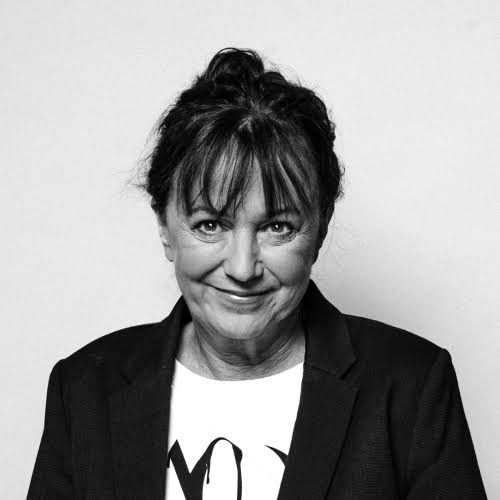 Steinunn G. Helgadóttir (b.1952) is a visual artist and well-known Icelandic poet and prose writer. She received The Icelandic Women’s Literature Prize 2016 for her novel Voices From the Radio Operator’s House. Helgadóttir’s work has been exhibited at solo and group art exhibitions around the world. She has also curated numerous art exhibitions in several museums and galleries in Iceland.

Lytton Smith is a poet, professor, and translator from the Icelandic. His most recent translations include works by Kristín Ómarsdóttir, Jón Gnarr, Ófeigur Sigurðsson, Bragi Ólafsson, and Guðbergur Bergsson. His most recent poetry collection, The All-Purpose Magical Tent, was published by Nightboat. Having earned his MFA and PhD from Columbia University, he currently teaches at SUNY Geneseo.
ABOUT THE MODERATOR
 Larissa Kyzer is a writer and Icelandic-English literary translator. Her translation work has been supported by the National Endowment for the Arts, the European Union Prize for Literature, the Fulbright Commission, the American-Scandinavian Foundation, the Icelandic Literature Center, Reykjavík UNESCO City of Literature, and Finland’s Kone Foundation. She is on the steering committee of the National Writers Union’s Literary Translators Division, on the board of the American Literary Translators Association, and in the process of launching Great Auk Books, a micropress dedicated to experimental Icelandic poetry and prose.